Monday, March 16, 2009

"Liar liar, pants on fire"

"Is it ever right to lie?"


The Bible nowhere presents an instance where lying is considered to be the right thing to do. The ninth commandment prohibits bearing false witness (Exodus 20:16). Proverbs 6:16-19 lists “a lying tongue” and “a false witness who pours out lies” as two of the seven abominations to the Lord. Love “rejoices with the truth” (1 Corinthians 13:6). For other Scriptures that speak negatively of lying, see Psalm 119:29, 163; 120:2; Proverbs 12:22; 13:5; Ephesians 4:25; Colossians 3:9; and Revelation 21:8. There are many examples of liars in Scripture, from Jacob’s deceit in Genesis 27 to the pretense of Ananias and Sapphira in Acts 5. Time after time, we see that falsehood leads to misery, loss, and judgment.There are at least two instances in the Bible where lying produced a favorable result. For example, the lie the Hebrew midwives tell Pharaoh seems to result in the Lord’s blessing on them (Exodus 1:15-21), and it probably saved the lives of many Hebrew babies. Another example is Rahab’s lie to protect the Israelite spies in Joshua 2:5. It is important to note, however, that God never condones these lies. Despite the “positive” outcome of these lies, the Bible nowhere praises the lies themselves. The Bible nowhere states that there are instances where lying is the right thing to do. At the same time, the Bible does not declare that there is no possible instance in which lying is an acceptable option.The question then remains – is there ever a time when lying is the right thing to do? The most common illustration of this dilemma comes from the life of Corrie ten Boom in Nazi Germany. Essentially the story is this: Corrie ten Boom is hiding Jews in her home to protect them from the Nazis. Nazi soldiers come to her home and ask her if she knows where any Jews are hiding. What is she to do? Should she tell the truth and allow the Nazis to capture the Jews she was trying to protect? Or, should she lie and deny that she knows anything about them?In an instance such as this, where lying may be the only possible way to prevent a horrible evil, perhaps lying would be an acceptable thing to do. Such an instance would be somewhat similar to the lies of the Hebrew midwives and Rahab. In an evil world, and in a desperate situation, it may be the right thing to do to commit a lesser evil, lying, in order to prevent a much greater evil. However, it must be noted that such instances are extremely rare. It is highly likely that the vast majority of people in human history have never faced a situation in which lying was the right thing to do.

Recommended Resource: Overcoming Sin and Temptation by John Owen.

LOL

Four Catholic ladies...

Four Catholic ladies are having coffee together. The first one tells her friends, "My son is a priest. When he walks into a room, everyone calls him 'Father'." The second Catholic woman chirps, "My son is a Bishop. Whenever he walks into a room, people say, 'Your Grace'." The third Catholic woman says smugly, "My son is a Cardinal. Whenever he walks into a room, people say, 'Your Eminence'." The fourth Catholic woman sips her coffee in silence. The first three women give her this subtle "Well.....?" She replies, "My son is a gorgeous, 6'2", hard bodied stripper. When he walks into a room, people say, 'Oh my God...'."

Q: What do you get if you cross Santa with a detective ?

A: "Santa Clues"

Cartoon of the Day


Saturday, March 14, 2009

"All have sinned...." BUT

"How bad can a Christian sin?"

Christians continue to sin after they are saved – we will not be completely free from sin until we die or Jesus comes back. However, becoming a Christian results in a changed life (2 Corinthians 5:17). A person will go from producing the acts of the flesh (Galatians 5:19-21) to displaying the fruits of the Spirit (Galatians 5:22-23), as the indwelling Holy Spirit has more and more control over his life. This change does not happen instantly, but it does happen over time. If a person does not demonstrate a changed life, he/she is likely not a genuine believer. Christians can commit grievous sins. History is filled with Christians (or those who claim to be Christians) committing terrible crimes. Jesus died for these sins as well. All the more reason not to commit them!In 1 Corinthians 6:9-11, the Apostle Paul describes the kind of sinful lifestyles believers are saved from. Verse 11 says, “And that is what some of you were. But you were washed, you were sanctified, you were justified in the name of the Lord Jesus Christ and by the Spirit of our God.” Notice the word “were.” Believers used to be like the things listed in verses 9-10, but they are not like that any longer. Can a person who is an adulterer, drunkard, or homosexual, child abuser, etc. be saved? Yes. Is a person who lives a life of continual sin a believer? No. When we become Christians, our lives will change. Anyone who is living a sinful lifestyle and claims to be a Christian is either lying, is self-deceived, or really is a believer who is going to experience God’s judgment and discipline (Hebrews 12:5-11).The difference between a sinning unbeliever and a sinning believer is that one loves his sin while the other hates it. The believer who stumbles in his walk with the Lord regrets it, confesses it, wishes to never do it again and seeks to appropriate God’s power and grace to avoid it. He doesn’t consider how much he can sin and still be considered a Christian. Rather, he considers how he can avoid even the appearance of sin in the future.

LOL

Christian Lion...


A Baptist missionary was walking in Africa when he heard the ominous padding of a lion behind him. "Oh Lord," prayed the missionary, "Grant in Thy goodness that the lion walking behind me is a good Christian lion." And then, in the silence that followed, the missionary heard the lion praying too: "Oh Lord," he prayed, "I thank Thee for the food which I am about to receive."

God's Creations

In the beginning, God created the earth and rested.

Then God created Man and rested.

Then God created Woman.

Since then, neither God nor Man has rested.

Cartoon of the Day

Friday, March 13, 2009

Featured Christian Celebrity of the Week

BeBe Winans

Benjamin "BeBe" Winans (born 17 September 1962) is a Grammy Award-winning gospel and R&B singer, and a member of the noted Winans family, most members of which are also gospel artists. He released several albums, first with his sister CeCe Winans, and later as a solo artist. The television show "Praise the Lord" (then known as "The PTL Club") took interest in BeBe and his sister CeCe as background vocalists for the show. After going to North Carolina to audition they were accepted. BeBe and CeCe moved to the PTL campus in North Carolina, and were on the show for about five years.
During their time on PTL, BeBe and CeCe recorded "Lord Lift Us Up" on PTL's label after popular demand on the show. Eventually the success warranted another effort: a full length album. The album did well on the charts. BeBe and CeCe left PTL to pursue their singing career and recorded five albums together including self titled BeBe & CeCe Winans, Heaven, Different Lifestyles, First Christmas and Relationships...(Read more)

Featured Bible Character of the Week

Abraham is a man featured in the Book of Genesis and an important figure in several monotheistic religions. Jewish, Christian and Muslim traditions regard him as the founding patriarch of the Israelites, Ishmaelites and Edomite peoples. He is widely regarded as the patriarch of Jews and Arabs and the founder of monotheism. According to the Hebrew Bible, Abraham means "Father of Many Nations." "Av" is Hebrew for "Father", and "Raham" is the Hebrew for "Many." Also considered to mean "High Father", coming from the Aramaic words "Aba Rama."
Abraham's father was Terah, the grandfather was Nahor. Abraham's brothers were named Nahor and Haran. According to Genesis, Abraham was brought by God from Mesopotamia to the land of Canaan. There Abraham entered into a covenant: in exchange for sole recognition of God as supreme universal deity and authority, he would be blessed with innumerable progeny. According to Christian traditional dates, Abraham lived about 2000 BCE to 1825 BCE.

"The Angel of the Lord..."

"Who is the Angel of the Lord?"

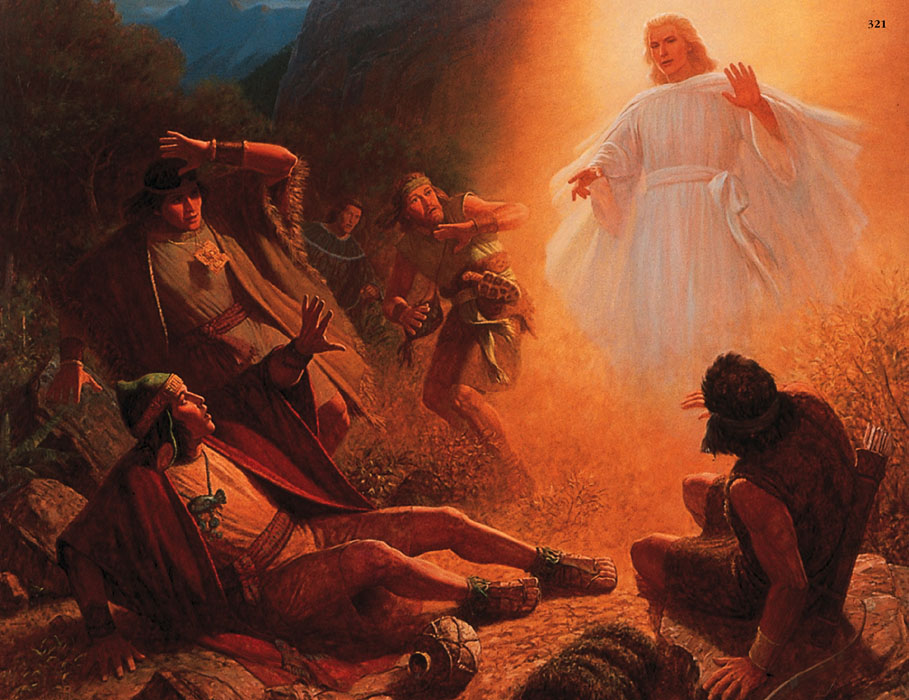
The precise identity of the "angel of the Lord" is not specifically given in the Bible. However, there are many important "clues" to his identity. There are Old and New Testament references to “angels of the Lord,” “an angel of the Lord,” and “THE angel of the Lord.” It seems when the definite article the is used, it is specifying a unique being, separate from the other angels. The angel of the Lord speaks as God, identifies Himself with God, and exercises the responsibilities of God (Genesis 16:7-12; 21: 17-18; 22:11-18; Exodus 3:2; Judges 2:1-4; 5:23; 6:11-24; 13:3-22; 2 Samuel 24:16; Zechariah 1:12; 3:1; 12:8). In several of these appearances, those who saw the angel of the Lord feared for their lives because they had "seen the Lord." Therefore, it is clear that in at least some instances, the angel of the Lord is a theophany, an appearance of God in physical form.The appearances of the angel of the Lord cease after the incarnation of Christ. Angels are mentioned numerous times in the New Testament, but “THE angel of the Lord” is never mentioned in the New Testament. It is possible that appearances of the angel of the Lord were manifestations of Jesus before His incarnation. Jesus declared Himself to be existent “before Abraham” (John 8:58), so it is logical that He would be active and manifest in the world. Whatever the case, whether the angel of the Lord was a pre-incarnate appearance of Christ (Christophany), or an appearance of God the Father (theophany), it is highly likely that the phrase “the angel of the Lord” identifies a physical appearance of God.

Recommended Resource: Angels: Elect & Evil by C. Fred Dickason.

LOL

Who will pay my bills...?

Mr. Smith was brought to Mercy Hospital (a Catholic hospital),and taken quickly in for coronary surgery. The operation went well and, as the groggy man regained consciousness, he was reassured by a Sister of Mercy, who was waiting by his bed. "Mr. Smith, you're going to be just fine," said the nun, gently patting his hand. "We do need to know, however, how you intend to pay for your stay here. Are you covered by insurance?" "No, I'm not," the man whispered hoarsely. "Then can you pay in cash?" persisted the nun. "I'm afraid I cannot, Sister." "Well, do you have any close relatives?" the nun questioned sternly. "Just my sister in New Mexico," he volunteered. "But she's a humble spinster nun." "Oh, I must correct you, Mr. Smith. Nuns are not spinsters - they are married to God." "Wonderful," said Mr. Smith. "In that case, please send the bill to my brother-in -law."

Amen instead of Awomen...
Q: Why do they say 'Amen' at the end of a prayer instead of 'Awomen'?

A: The same reason they sing Hymns instead of Hers!

Cartoon of the Day

Thursday, March 12, 2009

Guardian Angels...

"Do we have guardian angels?"

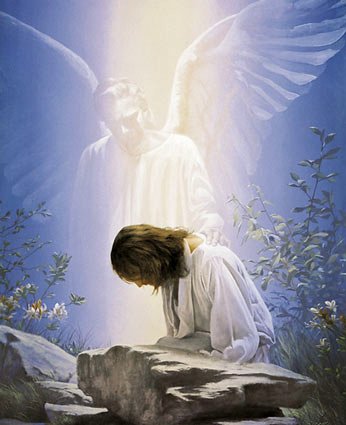
Matthew 18:10 states, “See that you do not look down on one of these little ones. For I tell you that their angels in heaven always see the face of my Father in heaven.” In the context, “these little ones” could either apply to those who believe in Him (v. 6) or it could refer to the little children (vv. 3-5). This is the key passage when the discussion of guardian angels comes up. There is no doubt that good angels help protect (Daniel 6:20-23; 2 Kings 6:13-17), reveal information (Acts 7:52-53; Luke 1:11-20), guide (Matthew 1:20-21; Acts 8:26), provide for (Genesis 21-17-20; 1 Kings 19:5-7), and minister to believers in general (Hebrews 1:14).The question that arises is whether each person—or each believer—has an angel assigned to him/her. In the Old Testament, the nation of Israel had the archangel (Michael) assigned to it (Daniel 10:21; 12:1), but nowhere in Scripture does it state that an angel was “assigned” to an individual (they were sometimes sent to individuals, but no mention of “permanent” assignment is given). The Jews had fully developed the belief in guardian angels during the time between the Old and New Testament periods. Some early church fathers believed that each person had not only a good angel assigned to him/her, but also a demon as well. The belief in guardian angels has been around for a long time, but there is no explicit scriptural basis for it.To return to Matthew 18:10, the word “their” is a collective pronoun in the Greek, and refers to the fact that believers are served by angels in general. These angels are pictured “always” watching the face of God so as to hear His command to them to help a believer when it is needed. If one is to take from the Matthew passage that guardian angels are referred to, it would seem that these angels are continually guarding a person, but rather “always see the face of” the Father in heaven. The active duty or oversight seems then to come more from God than the angels, which makes perfect sense because God alone is omniscient. He sees every believer at every moment, and He alone knows when one of us needs the intervention of an angel. Because they are continually seeing His face, the angels are at His disposal to help one of His “little ones.”It cannot be emphatically answered from Scripture whether or not each believer has a guardian angel assigned to him/her. But as stated earlier, God does use them in ministering to us. It is scriptural to say that He uses them as He uses us, i.e. He in no way needs us or them to accomplish His purposes, but chooses to use us and them nevertheless (Job 4:18; Job 15:15). In the end, whether we have an angel assigned to protect us or not, we have a greater assurance that God gives: if we are His children through faith in Christ, He works all things together for good (Romans 8:28-30), and that Jesus Christ will never leave us or forsake us (Hebrews 13:5-6). If we have an omniscient, omnipotent, all-loving God with us, does it really matter whether or not there is a finite “guardian angel” protecting us?

LOL

"The best part of wakin up..."

On Father's Day, a little boy decides to make his dad breakfast in bed. He makes scrambled eggs, toast and coffee. He brings it into his dad, hands him the cup of coffee and says,''Try it dad.''
The dad takes a sip and nearly passes out because it is so strong. The little boy asks,''How do you like it Dad?''
The dad doesn't want to hurt the little boy's feelings so he says, ''This is....something else, I've never tasted coffee quite like this before, Son.''
The little boy smiles from ear to ear. And says, ''Drink some more Pops.''
As the dad is drinking, he notices two army men in the bottom of the cup, and says,''Hey! Why did you put army men in here?''
The little boy again smiles and sings,''The Best Part Of Waking Up, Is SOLDIERS In Your Cup.''

Q: What's E.T. short for?

A: Because he has little legs!

Cartoon of the Day


Wednesday, March 11, 2009

LOL


A Famous Composer-Mozart Beyond the Grave...

When Mozart passed away, he was buried in a churchyard. A couple days later, the town drunk was walking through the cemetery and heard some strange noise coming from the area where Mozart was buried.
Terrified, the drunk ran and got the town magistrate to come and listen to it.
When the magistrate arrived, he bent his ear to the grave, listened for a moment, and said, "Ah, yes, that's Mozart's Ninth Symphony, being played backwards."
He listened a while longer, and said, "There's the Eighth Symphony, and it's backwards, too. Most puzzling."
So the magistrate kept listening; "There's the Seventh... the Sixth... the Fifth..."
Suddenly the realization of what was happening dawned on the magistrate; he stood up and announced to the crowd that had gathered in the cemetery, "My fellow citizens, there's nothing to worry about. It's just Mozart decomposing."


Q:What do you call ghosts who scare talkshow hosts?

A:The Phantom of the Oprah.